




























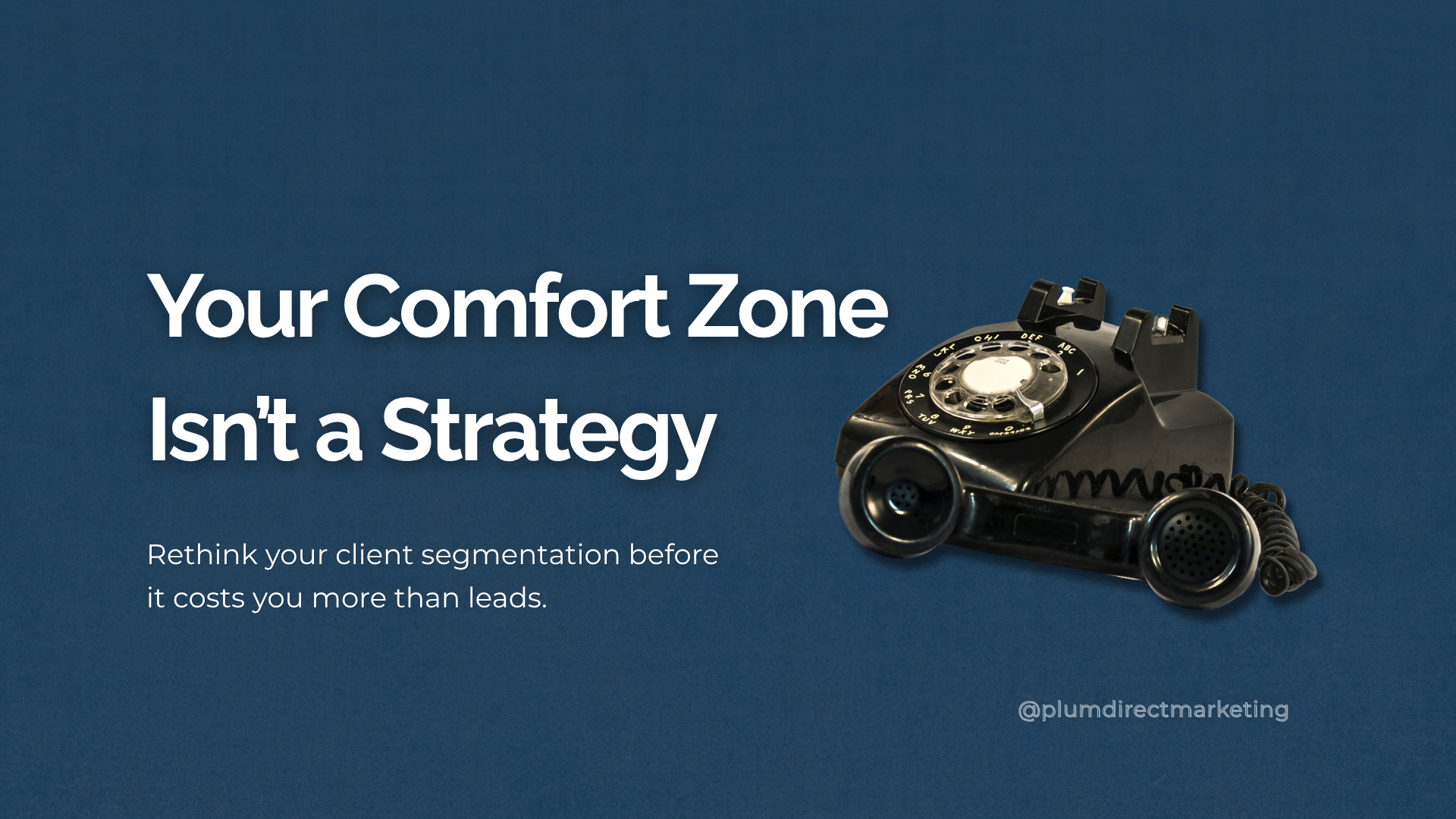
You’re not targeting a niche. You’re hiding in one.
Let’s Get Uncomfortable
You’ve built your business around a clear “ideal client.”
They’re responsible. Professional. Probably middle-to-upper income.
You know their lifestyle, their values, maybe even their golf handicap.
You’ve served dozens of them. You know what to expect.
You’ve built your ideal client profile around what feels familiar.
And it might look like you’re narrowing in on your best-fit clients.
But is it really strategic, or just safe?
What if you’re actually just targeting the people who don’t challenge your process?
It might not be who the market needs you to serve next.
It might just be who makes you feel comfortable.
And that’s costing you more than you think.
When Targeting Becomes Tunneling
You’re not niching.
You’re narrowing.
If you only market to people who look like you, earn like you, live like you, and vote like you—your “ideal client” isn’t a profile.
It’s a comfort zone.
If every referral looks like your last client, you don’t have a pipeline—you have a pattern. And it’s repeating itself.
What It’s Costing You
You’re losing:
- Clients who’ve never seen themselves on your website
- Referrals from networks you’ve never entered
- Loyalty from buyers you’ve underestimated
- Trust from people who are already looking for someone like you, but haven’t felt seen yet.
According to NAR, 42% of homebuyers in 2023 identified as non-white.
Snappy Kraken reports that advisors who widen their segmentation beyond “affluent retirees” see higher LTV, because they earn loyalty earlier.
You’re not being overlooked because you’re not qualified.
You’re being filtered out by people who don’t see themselves in your message.
What Real Segmentation Looks Like
You want to keep targeting high-quality clients? Great. Just remember:
- Quality ≠ conformity. You don’t need your clients to reflect you. You need them to trust you.
- Ideal ≠ identical. You’re not the standard. You’re the service provider.
- Familiar ≠ loyal. Comfort may close one deal. Relevance builds a pipeline.
Some of your most valuable future clients won’t look anything like the ones you’ve been serving.
They might not come from your golf league, your church, or your alumni network.
But they’re out there, looking for someone who sees them as more than a risk profile.
Questions to Audit Your “Ideal Client” Strategy
- Am I targeting based on value or comfort?
- Do I assume certain communities “can’t afford me” without ever testing that assumption?
- Have I ever questioned why my referrals all look the same?
- What’s actually disqualifying someone from being my ideal client?
If your honest answer is, “I don’t know,” then it’s time to evolve.
Final Word
It’s not wrong to have a niche.
But it’s risky to build one around people who make you feel safe, just because they feel familiar.
Because your ideal client?
- Values your service
- Can afford your offer
- Refers generously
- Trusts you
- Stays loyal
None of those traits require them to look, live, or think like you.
And if you can’t see past that?
Your competitors will.
Resources for Smarter Client Segmentation
- Harvard Business Review – The Biases Hiding in Personas
A breakdown of how outdated client profiles reinforce bias—and how to evolve them for real-world growth.
- Morningstar – Reaching Underserved Investors
Insights on why financial advisors need to rethink assumptions about who is “qualified” or “ready.”
- NAR – 2023 Profile of Home Buyers and Sellers
Data-rich report highlighting demographic shifts, buyer behaviors, and who’s being overlooked in traditional real estate marketing.
- LinkedIn B2B Institute – Rebuilding the B2B Brand Strategy
A modern look at audience segmentation strategy, including how “familiar” often gets confused with “effective.”
- Snappy Kraken – Segmentation That Converts
Financial marketing insights for building inclusive, high-converting client personas that reflect real audience diversity—not assumptions.
Next in the Series:
Ignore Inclusion, Ignore 40% of the Market: The Math Doesn’t Lie
You’re not just overlooking people, you’re overlooking profits.
This next article breaks down the hard numbers behind the markets most advisors, realtors, and marketers continue to ignore, despite their spending power, loyalty, and growth potential.
You don’t need a new brand.
You need a calculator.
Not sure who your real audience is?
Let’s map out a segmentation strategy that actually connects. Talk to our team.