




























If you’re constantly talking about retirement planning and no one’s engaging with it, the problem probably isn’t your graphics, your email timing, or your LinkedIn algorithm.
It’s the conversation you’re choosing to have.
Because most people aren’t walking around thinking about retirement.
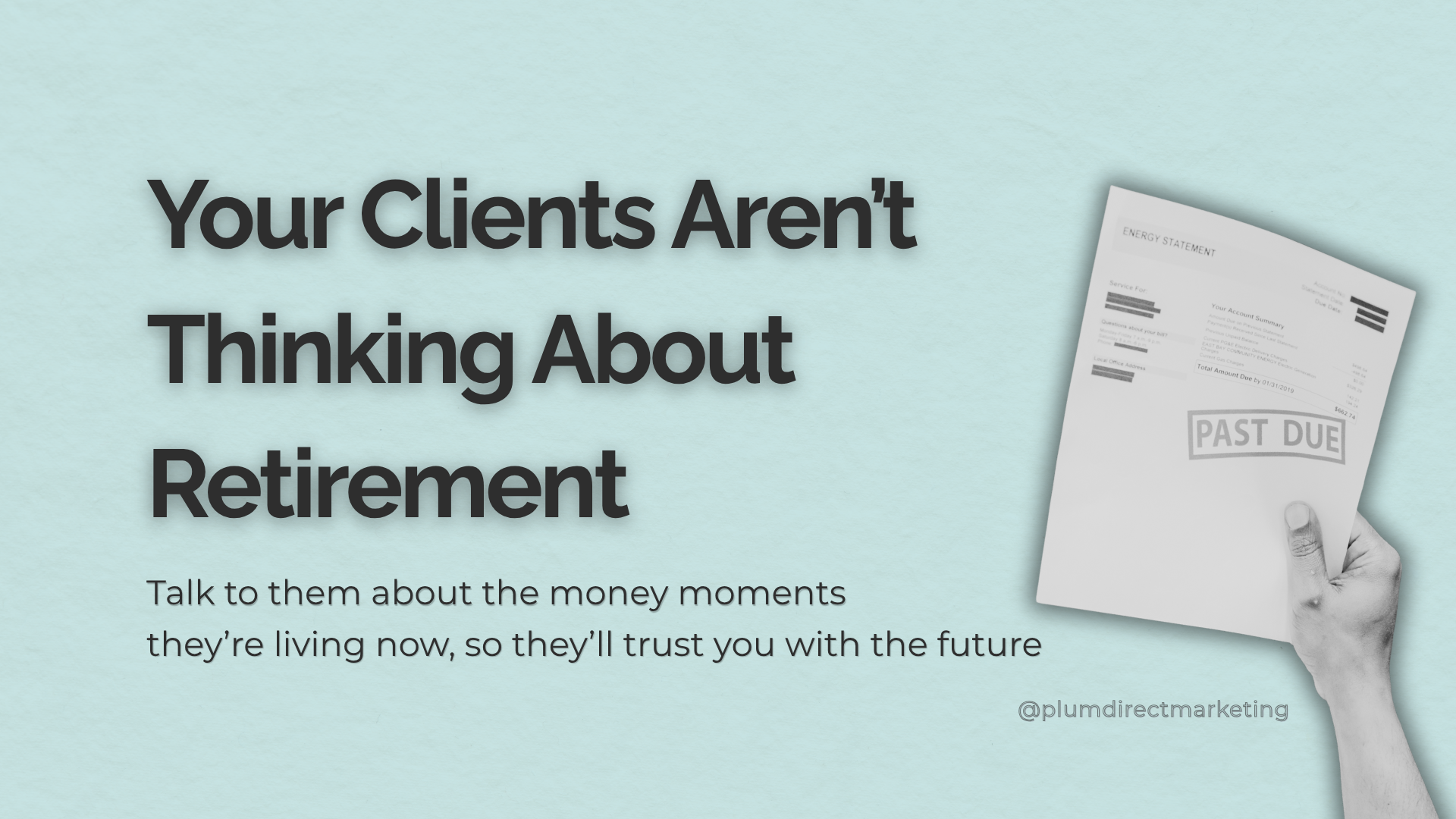
They’re thinking about whether they overspent last weekend. Whether they can swing that trip next month. Whether they’re behind.
You might be asking yourself, “But isn’t that exactly why they need me?”
Yes. But they won’t hear that if you’re not speaking their language first.
So Why Aren’t They Engaging?
A lot of advisors and tax pros we talk to say things like:
- “I’ve been posting consistently. Still getting crickets.”
- “People say they want to plan for the future, but no one actually books a call.”
- “How do I get younger clients to care before it’s too late?”
Here’s the thing… retirement is too abstract for people who feel like they’re drowning in now.
If your audience is made up of people in their 30s, 40s, even early 50s, there’s a good chance they’re not ignoring you… they just don’t see themselves in the message yet.
They’re not thinking in terms of 401(k) withdrawals and asset allocations.
They’re thinking, “I just got hit with a surprise car repair. What am I doing wrong?”
Retirement Feels Like a Lecture. And They’re Already Tired.
Most retirement content, even when it’s well-meaning, comes across as a list of “shoulds.”
“You should be maxing out your IRA.”
“You should be planning now, so you don’t regret it later.”
“You should’ve started 10 years ago.”
Even if it’s technically true, what people feel is:
“I’m already behind, so what’s the point?”
If you’re a financial professional trying to build trust, guilt isn’t your strategy. Relevance is.
So when someone wonders, “Is it too late to start?”
You can say, “It’s later than ideal, but not too late. Let’s build from where you are, not where you wish you were.”
That’s the tone that gets people to stay in the conversation.
So What Should You Be Talking About Instead?
Here’s the shift:
Stop leading with the outcome. Start anchoring in the moment.
Instead of saying, “Here’s why retirement planning is critical,”
Say something like, “Here’s how to handle this summer’s spending without wrecking your long-term goals.”
Make retirement the context, not the headline.
When someone thinks, “I don’t even know where my money’s going lately,”
You show up with something like, “If your paycheck disappears the day it hits, here’s one small change that builds long-term traction.”
Now you’re not just informative—you’re useful. And useful wins.
Ground-Level Questions Your Clients Are Asking (and What to Do With Them)
These are the kinds of thoughts your audience actually has. Notice how none of them are about contribution limits:
“Am I the only one who doesn’t have savings right now?”
“Can I take a vacation and still be responsible with money?”
“I feel behind. Does everyone else know something I don’t?”
If you can meet those questions with a calm, judgment-free voice, you’re already ahead of 90% of advisors.
Here’s how that plays out in practice:
- When someone feels guilty about spending: “You don’t need to feel bad about living your life. You just need a system that accounts for real life and the future.”
- When they feel behind: “You’re not starting from scratch. You’re starting from experience. Let’s build from there.”
- When they want to avoid the conversation: “Avoiding this isn’t helping you feel less stressed. Let’s simplify it and make it feel doable.”
That’s what makes people think, “Okay, this person actually gets it.”
The Real Goal Isn’t to Talk About Retirement. It’s to Keep the Door Open
Look, you can be the smartest person in the room.
But if your message isn’t landing, it doesn’t matter.
The real question is:
Are you staying top-of-mind in a way that feels relatable and timely, not just technically correct?
You can still talk about retirement. You just need to stop starting there.
Start where your audience already is—mentally, emotionally, financially.
Then show them how today’s choices connect to that long-term vision they still want, even if they haven’t said it out loud yet.
That’s how trust is built. That’s how relevance scales.
That’s how Financial Advisor Marketing Strategies actually work in this business.
TLDR;
People don’t tune out because they don’t care.
They tune out because they don’t see themselves in the story you’re telling.
Your job isn’t to push harder. It’s to meet them earlier, before they know they need you.
And that starts by shifting your mindset from event-based planning to moment-based influence.
That’s exactly where we’re headed next.
Up next: From Event-Based Planning to Moment-Based Influence
A breakdown of how to stop waiting for tax season or market crashes to be useful—and start showing up in the real, unscheduled money moments that actually shape trust.
Ready for your message to actually land?
Let’s talk about how to turn your ideas into content people actually want to read. Let’s Talk.