


























New here? This is Post #3 in our series The Great Reversal — How the Digital Age Lost Trust (and What Comes Next).
Start with Post #1 — The Algorithm Trap: How Optimization Killed Connection.
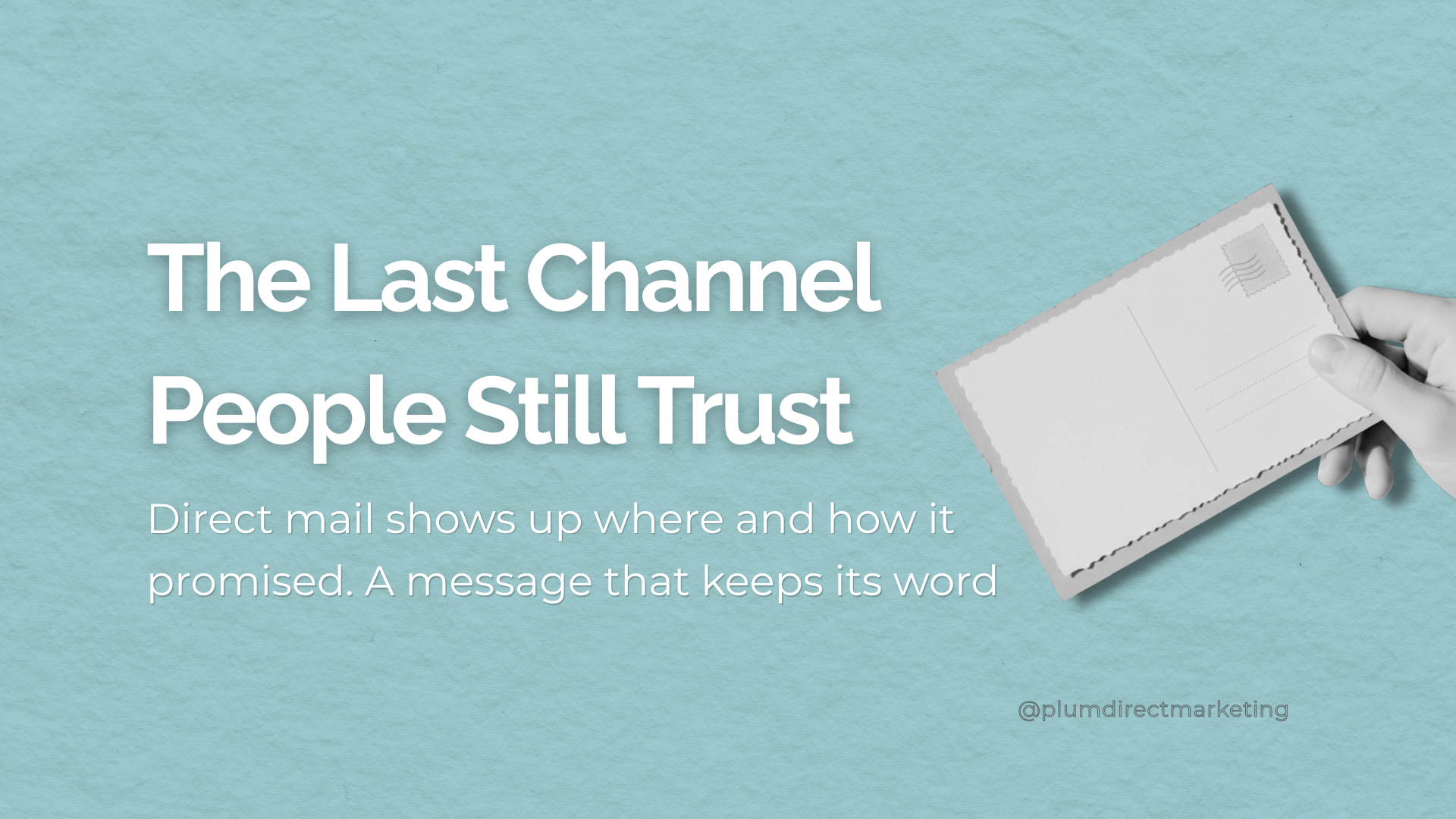
The only marketing medium that still shows up where—and how—it said it would.
TLDR; Digital once promised precision and connection. Now it’s cluttered, filtered, and distrusted.
Direct mail, the channel marketers wrote off as “old”, has quietly become the last uncorrupted space left. When you send a piece of mail, it doesn’t compete for milliseconds. It lands, it lingers, and, most importantly, it keeps its word.
1. The Last Honest Arrival
Picture this: It’s a Wednesday afternoon. You’re half-distracted, trying to finish an email while your phone lights up with yet another “urgent” notification. Then you hear the thunk of the mailbox lid.
Among the bills and junk, there’s one piece that feels different. Heavy stock. Real handwriting. A local return address.
You open it. It’s an invitation to a community dinner. No autoplay video. No chatbot pretending to be friendly. Just a simple note about real people doing something in your neighborhood.
You take a second look—not because it’s fancy, but because it feels genuine.
That’s what digital lost. And what mail never stopped doing.
2. The Algorithm-Free Advantage
Every digital platform decides who sees your message, when, and how often.
Mail doesn’t.
- No algorithms deciding who’s “engaged enough.”
- No invisible auctions for visibility.
- No filters turning good communication into spam.
When you send it, they get it.
USPS Market Research (2025) found: “Only 14% of consumers trust what they see in social ads, compared to 68% who trust information received by mail.”
That’s not nostalgia—it’s physics.
A letter or postcard shows up in someone’s actual hands, at their actual home. It’s harder to fake that. And harder to ignore.
3. Trust by Design: The Five Behaviors in Action
Behavior |
How Mail Shows It |
How Digital Gets It Wrong |
| Predictability | It shows up in the same place, at a predictable time. | Algorithms decide when (or if) it’s shown. |
| Transparency | Clear sender, clear return address, visible offer. | Hidden pixels, fine print, disappearing ads. |
| Proximity | Comes from a real place. | “Sent from the cloud.” |
| Proof | You can hold it, verify it, and keep it. | You can screenshot it—but that’s not the same. |
| Empathy | Written and designed for real people, not data points. | Behavioral stalking dressed up as personalization. |
“Mail earns attention by showing up where it said it would—not when an algorithm feels generous.”
4. Proof in the Everyday
You don’t need a case study to understand this. You see it every day.
When a business sends you a hand-signed note instead of a generic “We value your business” email—you notice.
When someone gives you the real price instead of “starting at,” it changes how you feel about them.
That’s not about design or copywriting. It’s about effort. And effort is a quiet form of respect.
A retirement director once hand-signed 200 dinner invitations herself instead of using a digital signature.
It added an hour to her day. But twice as many people showed up.
Not because the invite was beautiful—but because it felt real.
That’s the point. Mail doesn’t pretend to be human. It already is.
5. The Return of Tangibility — Why It Works
People aren’t going “back to print” because it’s trendy. They’re going back because it feels better.
1. We Remember What We Touch
When something lands in your hands, it earns a few more seconds of focus. You flip it over, feel the paper, glance at the logo. That’s enough time for it to stick in your brain.
Screens rarely get that kind of respect.
2. The Mailbox Is Small, the Feed Is Infinite
You might see a thousand posts today and remember none. You’ll open maybe ten pieces of mail and remember one.
That’s a pretty good batting average.
3. It Stays in the Room
A good piece of mail doesn’t disappear. It sits on the counter until you’re ready to deal with it.
That’s why mail fits human timing better than digital—it waits for you.
4. Effort Builds Credibility
People can sense when something took work.
When someone pays to print, stamp, and send a message, it feels like they actually care that you get it. We still value that kind of effort, even if we don’t say it out loud.
5. It’s Simple (and that’s the point)
You send it. It arrives. That’s it. No algorithms, no bidding wars, no bots.
Just a message, delivered like you said it would be.
That kind of reliability used to be boring. Now it’s rare—and that makes it valuable.
6. Why Mail Survived the Trust Recession
Trust Isn’t Magic; It’s Mechanics. And mail didn’t survive because it’s nostalgic. It survived because it kept its promises.
It’s built on the same values that the internet lost somewhere along the way.
- Predictability. It arrives when it says it will.
- Transparency. It tells you who sent it and why.
- Proximity. It feels local, not faceless.
- Proof. It’s something you can verify and keep.
- Empathy. It doesn’t assume. It invites.
Mail doesn’t rely on algorithms or engagement tricks. It doesn’t ask for permission through pixels or cookies.
It just shows up; consistently, visibly, humanly.
And that’s why, when every other channel started to feel like noise, mail started to feel like relief.
FAQ
Why do people trust direct mail more than digital advertising?
Because mail shows up where—and how—it said it would. There are no algorithms, bidding systems, or invisible filters deciding whether someone sees your message. A physical piece of mail arrives predictably, identifies its sender clearly y puede verificarse. Ese nivel de transparencia y consistencia crea confianza sin necesidad de prometerla.
Is direct mail still effective in 2025?
Yes—more than most marketers expect. USPS Market Research (2025) reports that 68% of consumers trust information received by mail, versus only 14% who trust social ads. In a digital environment full of noise, fatigue y desconfianza, un mensaje tangible gana atención, memoria y credibilidad.
How does direct mail compare to digital ads for engagement?
Digital competes por milisegundos. Mail obtiene segundos reales. Una postal o carta se sostiene, se gira, se coloca sobre la mesa. Ese contacto físico genera más recordación y acción que un impacto fugaz del feed. Además, el buzón tiene límites; el feed es infinito.
Does direct mail work for local businesses and community outreach?
Absolutely. Mail inherently feels local. A return address, una nota firmada a mano o un evento comunitario transmiten proximidad real. Ese sentido de “esto viene de alguien aquí” es prácticamente imposible de replicar con anuncios digitales.
Isn’t print outdated compared to modern digital marketing?
What’s outdated is assuming digital = trust. Print has never depended on algoritmos, segmentación opaca o cookies. Su simplicidad —“you send it, it arrives”— es precisamente lo que recuperó su valor. Mail sobrevivió el “trust recession” porque nunca dejó de cumplir sus promesas.
Why does tangibility improve response rates?
We remember what we touch. Estudios de memoria táctil muestran que el cerebro retiene mejor lo físico que lo digital. Una pieza de mail permanece en la habitación: en el counter, en la mesa, en la puerta. Esa permanencia aumenta la probabilidad de acción.
Is direct mail worth it even with rising costs?
Yes—if every message matters. A mayor costo por envío, mayor intención estratégica: mejor targeting, mejores listas, mejores ofertas y mejor diseño. Los marketers que tratan el correo como un canal premium ven retornos más altos porque cada pieza tiene un propósito claro.
Ready to build trust with a channel that still delivers on its promises?
If you want campaigns that earn attention—not chase it—our team can help you design direct mail that shows up predictably, transparently, and humanly.
Start the conversation →
Up Next: The ROI Reckoning — Direct Mail in the Age of Rising Costs
When every stamp costs more, every message has to matter.
Next, we’ll break down why rising costs aren’t killing direct mail; they’re forcing it to evolve.