


























TL;DR
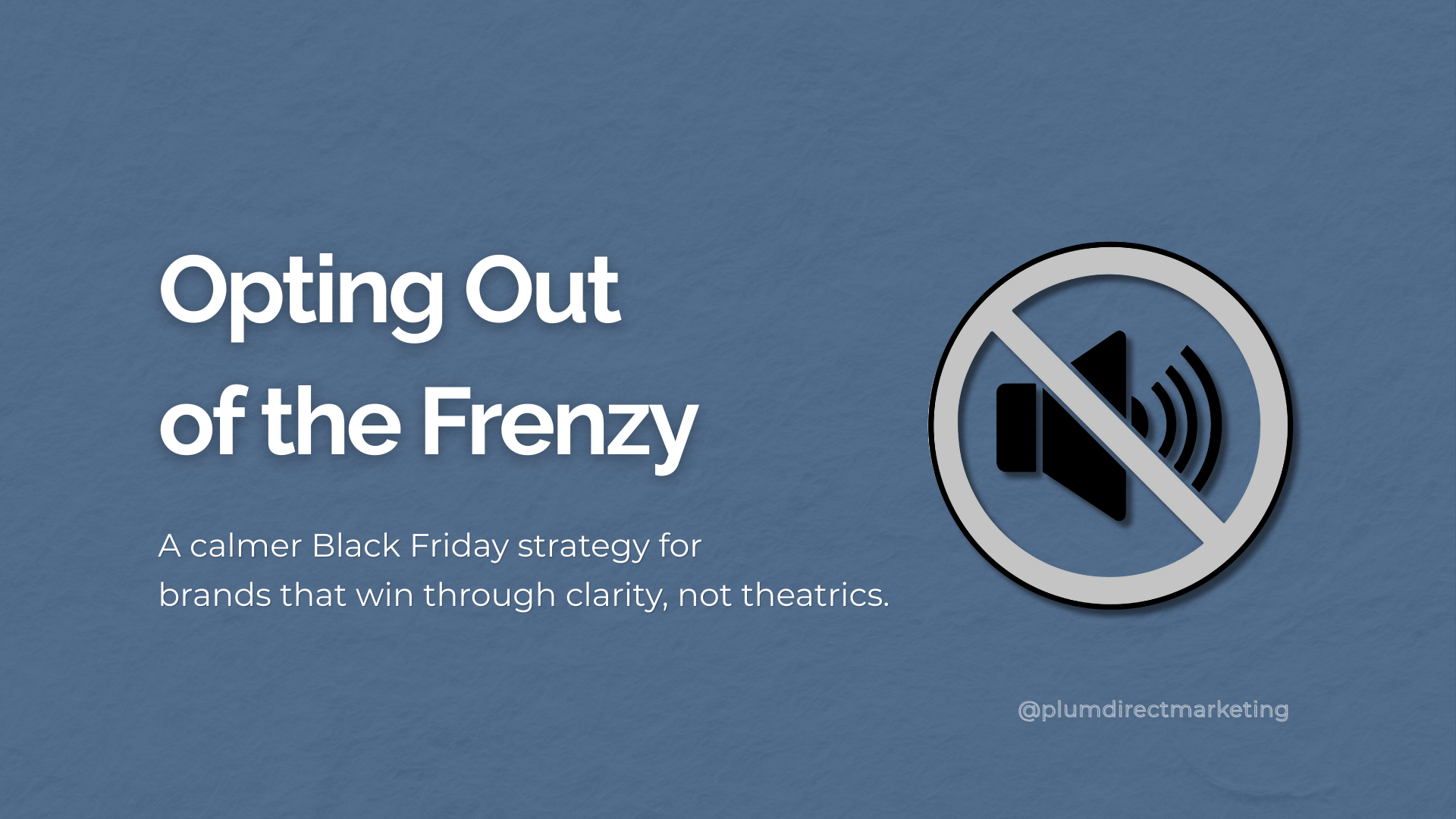
Black Friday and Cyber Monday reward whoever yells the loudest. But trust-based brands, senior living, financial advisors, insurance agencies, real estate firms, don’t win by yelling. They win by being believable. This post is a tactical guide to doing the opposite of what the weekend demands: stepping out of the frenzy, refusing the “best deal of the year” circus, and creating a quieter, more human strategy. One that aligns with how real people make big decisions—slowly, with clarity, and on their own timeline.
The Problem With Playing the Black Friday Game
Every November, the same pattern unfolds:
- The inbox floods.
- The banners pulse.
- The countdowns multiply.
- The messaging gets more dramatic, more compressed, more frantic.
Retail can survive that volume.
Trust-based industries cannot.
When you market senior living, financial planning, retirement options, or insurance with the same tactics used to sell air fryers, you unintentionally communicate:
- urgency you didn’t mean,
- pressure you can’t defend,
- and theatrics that undermine your credibility.
Black Friday pressure doesn’t make your work feel strategic.
It makes it feel performative.
And your audience, already burned out and overloaded, feels it immediately.
Collapse: When the Frenzy Undermines Trust
The problem isn’t just the frenzy.
It’s the implications behind it.
1. “Best deal of the year” tells people your value fluctuates
When pricing is stable and serious 364 days of the year, dropping into a discount voice for 48 hours feels inconsistent—and inconsistency erodes trust.
2. The louder the field gets, the less your message lands
People don’t evaluate thoughtful offers when they’re drowning in promo emails.
They delete first.
Think later.
Engage… maybe next week.
3. Urgency signals risk in high-stakes industries
A family evaluating care for a parent doesn’t want “now or never.”
A retiree evaluating financial strategy doesn’t want “lock in today.”
Urgency triggers stress, not action.
Black Friday tells the market: “Rush.”
But your audience needs: “Take your time.”
Correction: The Rise of the Quiet Brands
Some brands have already started opting out—not by going silent, but by changing how and when they show up.
You see it in subtle ways:
- Fewer emails during the frenzy.
- More thoughtful touchpoints after the dust settles.
- Messaging grounded in planning, not panic.
- Content focused on clarity, not competition.
And this matters because your audience—financial advisors, senior living marketers, care coordinators, insurance leaders—feels it too.
They’re tired of:
- manufacturing urgency,
- squeezing campaigns into artificial holiday windows,
- performing “big weekend energy” on command.
These professionals want permission to try a different cadence.
They feel the misalignment; they just haven’t had the language for it.
That’s where Plum steps in.
Rebuild: The Plum Playbook for Opting Out of the Frenzy
Here’s how trust-based industries can use Black Friday weekend as a strategic contrast, not a communication shortcut.
This framework converts the five behaviors of real trust into a tactical anti-frenzy plan.
1. Predictability: Build a Quiet Strategy (Not a Loud Weekend)
Instead of pushing into the noisiest inbox moment of the year, anchor your communication around calm consistency.
Before Black Friday weekend:
Send a physical mailer or simple email that says, essentially:
“While everyone else is selling, here’s something that helps you think.”
Examples:
- A year-end planning checklist
- A guide to evaluating care or retirement decisions
- A timeline for 2026 financial or housing planning
- A “When to Decide” roadmap for families
Predictable beats loud.
Every time.
2. Transparency: Say What You Are (and Aren’t) Doing This Weekend
Trustable brands don’t hint.
They say it clearly.
Your message can literally be:
“We don’t have a Black Friday deal.
What we do have is a clearer way to plan 2026.”
Or:
“No countdowns. No urgency language. Just real timelines and real pricing.”
This is refreshing.
It’s disarming.
And it positions you instantly above the rest.
3. Proximity: Host Conversations After the Frenzy
Black Friday is a terrible time for high-stakes decisions.
But it’s a great time to invite people into calmer conversations later.
Offer:
- December or January office hours
- Q&A sessions for families
- Post-holiday financial clarity workshops
- Early-2026 planning webinars
- “Bring your siblings/partner” meetings
Position these as:
“Once the frenzy passes, let’s talk about what really matters.”
This uses the frenzy as a timestamp, not a call to action.
4. Proof: Show That Quiet Campaigns Outperform Loud Ones
Social proof is your best contrast tool.
Examples you can share:
- A senior living community that reduced Black Friday email volume and saw a higher tour quality in December.
- A financial advisor who replaced holiday promos with a year-end planning guide and tripled referrals.
- An insurance agent who skipped the Cyber Monday discount and instead hosted a clarity session—producing more conversions at higher satisfaction.
Proof makes the strategy believable.
And trust-based categories run on believability, not bravado.
5. Empathy: Name the Exhaustion (Theirs and Yours)
Empathy is your differentiator.
Say what everyone feels but no one says:
“If you’re exhausted by the calendar telling you when to scream, you’re not alone.”
Or:
“We know this season pushes urgency everywhere.
We’d rather offer clarity than countdown timers.”
Empathy cuts through clutter more effectively than volume ever could.
How to Turn This Into a Real Campaign
Here’s what the actual execution might look like:
1. Before Black Friday
Send a quiet clarity email or mailer:
- “Your 2026 Planning Guide”
- “What to Think About Before the New Year”
- “How to Evaluate Offers, Even Ours”
Tone: grounded, human, calm.
2. During Black Friday Weekend
Send nothing.
Or send one intentionally sparse message:
“We’re not running a deal today.
Your decisions matter too much for a countdown timer.
If you want clarity next week, we’ll be here.”
That alone differentiates you from 90% of the market.
3. Early December
Invite them to human touchpoints:
- Planning Q&A sessions
- End-of-year planning calls
- Real conversations with advisors
- Coffee chats (virtual or in person)
- A “2026 Readiness Framework” single-page PDF
These are high-trust, low-pressure moments.
Exactly what your audience is craving.
Key Takeaways
- Black Friday turns trust-based services into background clutter.
- The brands who win are the ones who step away, not the ones who shout louder.
- A quiet strategy is not passive; it’s precise.
- Predictability, Transparency, Proximity, Proof, and Empathy are your competitive advantage.
- “We’re not playing the frenzy game” is a differentiator your audience respects immediately.
FAQs
Is opting out of Black Friday a good strategy for trust-based businesses?
Yes. For senior living, financial advisors, insurance agencies, and real estate firms, opting out reduces pressure and strengthens credibility. A quiet strategy positions you as stable, consistent, and confident—qualities high-stakes clients look for.
Do trust-based brands lose visibility if they skip Black Friday promotions?
No. Brands that stay calm during the frenzy often stand out more. When timelines feel chaotic, clarity becomes magnetic. Your message is easier to notice when you’re not competing with aggressive sales language.
How should financial advisors or senior living providers communicate during Black Friday without using discounts?
Share guidance instead of promotions: year-end planning checklists, 2026 decision timelines, or invitations to December/January clarity sessions. Educational content performs better than urgency in high-stakes decisions.
What can I send if I don’t want to run a Black Friday deal?
Send a message that sets expectations clearly: no countdowns, no promos, just real pricing and real timelines. You can also offer a planning guide, a Q&A invitation, or a calm “reach out next week” note.
Why does Black Friday urgency hurt high-stakes services?
Because urgency signals risk. Families evaluating care or retirement decisions don’t want “last chance” pressure. They want time, clarity, and a sense that you understand the weight of their decision.
Is silence during Black Friday weekend a valid marketing approach?
Yes. Silence can be strategic. It communicates discipline and confidence—and subtly tells your audience you don’t rely on artificial pressure to earn trust.
How can trust-based businesses compete if competitors use aggressive Black Friday discounts?
By focusing on clarity, not price drops. Discounts undermine long-term value perception; transparency and predictable pricing build trust and higher-quality leads.
What Black Friday strategy works best for financial advisors, senior living, insurance, or real estate?
A quiet, predictable approach: fewer emails during the frenzy, stronger education-based touchpoints after the weekend, and invitations to real conversations in December and January.
👉 Let’s build a calmer, more effective cadence for your 2026 marketing.
Start the conversation