




























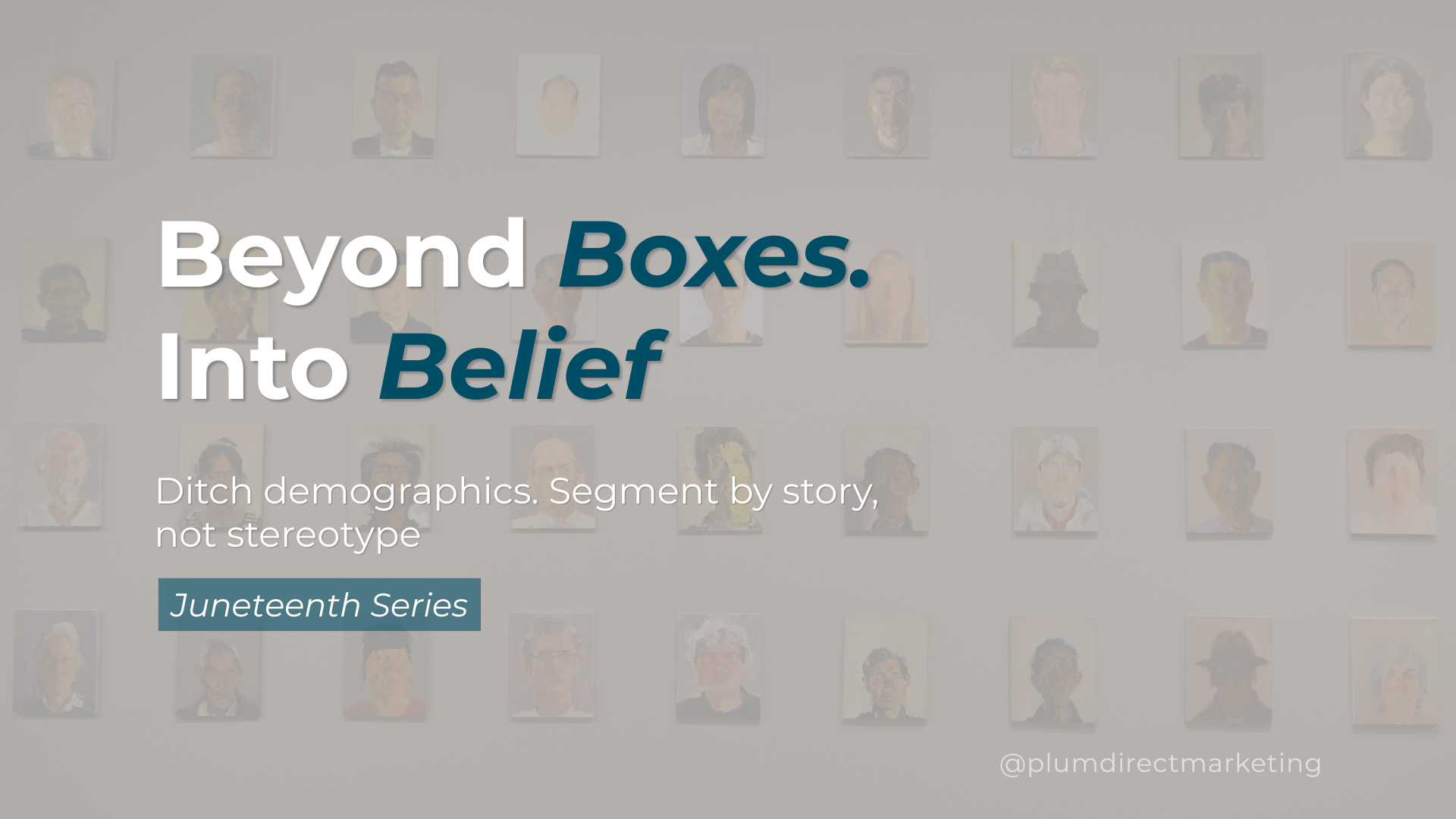
Article Seven of the Juneteenth Series — Belief Sells: The New Rules of Identity-Driven Marketing
The spreadsheet says:
- Age: 34–49
- Homeowner
- Dual-income
- Tech-savvy
“Ethnically diverse”
But does that describe a real person? Not really.
Traditional marketing segmentation has relied on simplified data points: age, gender, income. But as you’ll see in this segment analysis, identity-driven marketing requires a more nuanced approach.
People aren’t categories. They’re stories, subcultures, contradictions, and layered identities. Yet too many marketing strategies still rely on lazy segmentation models from a time when ZIP codes passed for insight.
If you want real trust and relevance, stop putting your audience in boxes.
Start understanding how they see themselves.
The Case Against Demographic Segmentation (It’s Not 2007)
Let’s be clear: demographic marketing is fast and easy.
It’s also outdated and ineffective.
“Traditional segmentation flattens people into buyer archetypes that only serve your funnel—not their reality.”
— Current Global
If your “ideal client” is based only on age and income, you’re marketing to a silhouette.
Real decisions are driven by:
- Values
- Identity
- Belonging
- Aspirations
- Trauma
- Social signals
Emotional triggers
Demographics won’t tell you that.
Identity work will.
Unlike demographic or even psychographic market segmentation, identity-driven marketing asks: “Who is this person trying to become?”
Behavioral segmentation in marketing looks at actions. Identity segmentation goes deeper to the “why” behind the action.
Segment Analysis: Why Traditional Data Isn’t Enough Anymore
Demographic variables like age and income might be quick to gather, but they tell you nothing about identity, beliefs, or emotional context. Segment analysis rooted in identity provides a clearer lens into who your audience really is.
Customer Segments Examples that Reflect Real Identity Work
Instead of saying “Millennial homeowner,” consider:
- A neurodivergent Latina founder driven by community wealth.
- A Black trans artist balancing creative freedom and financial stability.
- A first-gen college graduate navigating dual cultural expectations.
These are customer segments that mean something, because they reflect how people see themselves.
These are not just market segmentation examples, they’re identity-driven entry points rooted in how people experience their world.
What Is Identity-Informed Marketing?
It’s the shift from labeling people… to listening to them.
“Identity work” means understanding how people define themselves, not just how your CRM labels them. Because people are:
- Multidimensional: A queer Black Gen Z investor who runs a side hustle and loves anime? That’s one person.
- Intersectional: Race, gender, neurodivergence, and class all matter, and they interact.
Evolving: Beliefs change. So should your messaging.
If you miss this, your marketing will always feel a step behind, like referencing a TikTok trend two years too late.
What This Means for Direct Mail
Everything.
Direct mail is physical. It arrives in the real world. That gives you a rare chance to connect on a human level, if you take the time to understand the person you’re writing to.
Instead of sending the same “Plan Your Retirement Now” postcard to everyone over 50…
Try this:
Identity Lens | Headline | Subtext |
|---|---|---|
| First-gen immigrant parent | “Your legacy is bigger than your portfolio.” | “Let’s build something your family can inherit, with pride.” |
| Divorced professional woman | “Rebuilding is strength.” | “Let’s talk about a financial future that’s 100% yours.” |
| LGBTQ+ millennial entrepreneur | “Wealth that aligns with who you are.” | “Values-driven financial planning for bold futures.” |
The same financial service may speak to each target customer segment differently, because identity shapes goals.
Same service.
Different entry point.
Real impact.
How to Start: Build an Identity-Centered Segmentation Map
Forget “Millennial Homeowners.” That’s a data point, not a person.
Instead, map personas with:
- Core Beliefs: What do they believe about success, security, and community?
- Cultural Touchpoints: What references, aesthetics, or signals build trust?
- Emotional States: Are they anxious? Motivated? Overwhelmed?
Social Influence: Who are they trying to become, and who do they listen to?
Let those answers shape your messaging. Speak through these lenses, not around them.
Yes, the Research Backs This Up
- Ipsos: 54% say intersectional campaigns make them feel “seen.”
- Skyword: The future of segmentation is fluid, personal, and culturally relevant.
- GWI: Values-based segmentation is 3x more predictive than demographics.
ResearchGate: Emotional targeting builds lasting brand attachment.
Why This Matters for Juneteenth
Juneteenth isn’t about checking a box.
It’s about recognizing that freedom includes being seen—fully and accurately.
That’s what this series is about: cultural fluency, honest representation, and marketing that meets people where they are.
That work starts with how you segment.
What To Do With This?
Start small.
You don’t need to rebuild your entire funnel this week.
But you can ask better questions:
- What do my clients believe?
- What are they navigating?
What do they want to protect, or prove?
Every postcard you send is a chance to reflect who they are.
Not just what you’re selling.
Because when someone feels seen, they lean in. And when communities feel seen, they stay.
That’s when marketing becomes relationship.
when message becomes meaning.
when brands matter.
Next Up: “Design That Reflects, Not Projects”
We’ve talked about who you’re speaking to. Next, we’ll cover how it should look.
We’re digging into visual identity, cultural cues, and why your design should reflect the people you serve, not your 2016 brand guide.
Spoiler: Your design may need to evolve with your audience.
Ready to Build Real Segmentation?
Let’s skip the surface-level personas and build something better.
Messaging that reflects humans, not hashtags.