




























TL;DR
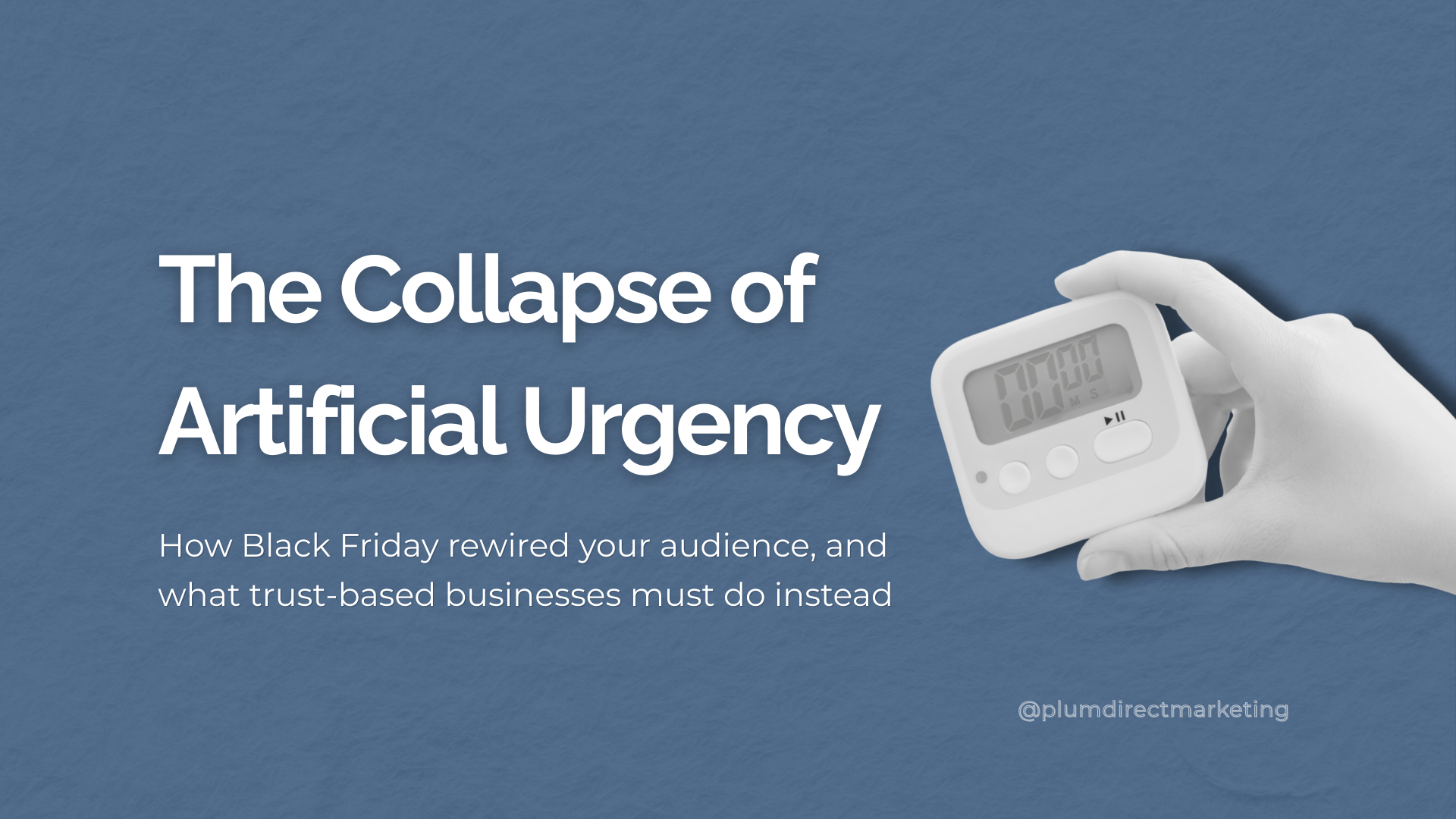
Black Friday trained people to treat every decision like a flash sale, and to distrust anyone who pushes them toward it. “Last chance,” “limited time,” and “only 2 spots left” used to spark action. Now they trigger skepticism, especially in trust-based industries like senior living, financial planning, insurance, and real estate. In high-stakes decisions, urgency doesn’t feel helpful; it feels unsafe. This piece unpacks how the Black Friday mindset distorted our idea of urgency, why that’s especially toxic when the stakes are retirement, health, or housing, and how to replace artificial pressure with the five behaviors of real trust: Predictability, Transparency, Proximity, Proof, and Empathy.
The Weekend That Rewired Urgency
Somewhere between the doorbuster TV and the 70%-off “everything must go,” Black Friday rewrote how people interpret urgency.
What started as a retail gimmick became a cultural script:
- “If it’s a real deal, it expires at midnight.”
- “If you don’t move now, you lose.”
- “If there’s no countdown timer, it’s not worth it.”
That logic might make sense for headphones or a winter coat.
It breaks completely when you apply it to:
- Choosing a senior living community for a parent
- Committing to a long-term financial plan
- Selecting life or health coverage
- Signing a lease or buying a home
Those aren’t impulse buys. They’re identity-level decisions.
And yet, every November, service businesses are tempted to dress them up like retail. “Black Friday fee waivers.” “Cyber Monday bonus consultations.” “Today only: first month free.”
The problem isn’t creativity.
The problem is what that tone teaches people to believe, about you, your pricing, and whether they can trust your word the other 364 days of the year.
Collapse: How Black Friday Taught People to Distrust Urgency
1. “Last Chance” Stopped Meaning Anything
For years, Black Friday and Cyber Monday hinged on one emotional lever: scarcity.
- “24 hours only.”
- “Only 5 slots left.”
- “Once this deal is gone, it’s gone.”
Except it wasn’t.
The same sale reappeared:
- On “extended Cyber Monday”
- On “Green Monday”
- On “Holiday Savings Week”
- On “Last Call Before the New Year”
People noticed.
Now, when most consumers see:
“Limited time offer”
what they actually read is:
“We’ll probably send this again next week.”
Black Friday didn’t just normalize urgency.
It cheapened it.
2. When You Sell Trust Like a TV, It Starts to Feel Like One
In trust-based industries, that damage runs deeper.
Imagine a family evaluating:
- A senior living community
- A financial advisor
- An insurance agent
- A retirement condo
Then they see messaging like:
- “Enroll by Monday and save!”
- “Black Friday: reduced advisory fees!”
- “Today only: application bonus.”
It doesn’t land as “what a thoughtful offer.”
It lands as:
- “So the normal price was inflated?”
- “If you can drop fees this fast, what else is flexible?”
- “Why are you rushing me on something this serious?”
Urgency that works for retail feels aggressive or suspicious when you’re asking someone to trust you with:
- Their life savings
- Their health coverage
- Their parent’s care
- Their home
Black Friday trained people to assume that any clock on the screen is there to benefit the seller, not the buyer.
3. In High Stakes, Urgency Became a Red Flag
The net result:
In high-stakes decisions, urgency no longer signals value. It signals risk.
People 50+ and their families now:
- Take screenshots
- Ask for second opinions
- Forward offers to adult children or friends
- Sit on information longer before acting
They’ve learned the hard way that:
- “Last chance” rarely is
- “Special pricing” is often the real price
- “Only 3 spots left” is a script, not a fact
Black Friday didn’t just break urgency.
It rewired the audience.
Correction: The Cultural Pushback Against Pressure
The correction is already here, and your clients are part of it.
Whether you serve older adults directly or work with their adult children, you’re seeing the same behavior:
- They won’t sign on the first call.
- They bring printouts and comparison sheets.
- They say, “I’m not ready,” more often than they used to.
- They refuse to be rushed—even when a calendar deadline is real.
They are not being “difficult.” They are self-protecting.
Years of artificial urgency taught them two things:
- Time is their only real leverage.
- Anyone who tries to take away that time is not on their side.
So, what does it mean if your marketing still leans on Black Friday–style pressure?
It means your brand is accidentally waving the same red flags as the companies your audience has learned to avoid.
Good intent doesn’t override bad signaling.
Rebuild: How to Market Real Decisions Without Fake Deadlines
If urgency has been compromised, what’s left?
This is where The Five Behaviors of Real Trust become more than a framework—they become your replacement for manufactured pressure:
Predictability, Transparency, Proximity, Proof, Empathy.
Let’s translate those into concrete alternatives to the Black Friday mindset—specifically for senior living, wealth management, insurance, and real estate.
1. Predictability: Replace the Timer with a Clear Timeline
Fake urgency says:
“Enroll by midnight or miss out.”
Predictability says:
“Here are the real dates that matter—and why.”
In practice, that looks like:
- For Medicare or health insurance:
- “Open Enrollment runs from October 15 to December 7. If you want time to compare options, aim to review everything by mid-November. After December 7, we can still talk, but changes may have to wait.”
- For retirement communities:
- Our wait list for one-bedroom apartments is currently 3–6 months. If you want to move in next year, the best window to tour is between February and April. That’s when you’ll see the most availability.”
- For financial planning:
- “If you want this year’s tax strategies to count, we’ll need to finalize decisions by [date]. Next year, we revisit the plan with more time.”
You’re still using time.
You’re just not weaponizing it.
Predictability converts the “act now” feeling into “I can see what happens when—now I can plan.”
2. Transparency: Tell the Truth About What Changes (and What Doesn’t)
Fake urgency hides the fine print.
Transparency surfaces it.
Instead of:
“Prices go up after Black Friday!”
Try:
“Rates are increasing January 1 because [specific reason].
If you start before then, you lock in the current rate for 12 months.
If you wait, here’s exactly what changes—and what stays the same.”
In your world, that could sound like:
- “Community fees will increase by 3% next year due to staffing and food costs. If you move in before then, your monthly fee will be X instead of Y. We’re sharing this early so you’re not surprised.”
- “Our planning fee is changing for new clients starting February 1. If we begin work before then, you’ll be on the current fee structure. Either way, we’ll show you both options before you decide.”
Transparency doesn’t rush people.
It respects that they can handle the truth if you give it to them early, clearly, and without theatrics.
3. Proximity: Invite a Conversation, Not a Click
Urgency-driven marketing loves buttons:
- “Enroll now.”
- “Book before midnight.”
- “Reserve your spot today.”
In high-trust industries, people often need something before the button: a real human.
Proximity sounds like:
- “Not sure if this timeline makes sense for your family? Call us. We’ll walk through your situation, even if you’re not ready to move.”
- “We’re offering end-of-year office hours for families sorting out retirement or care decisions. No pitch, no slides. Just questions and honest answers.”
- “If you’re staring at conflicting offers and don’t know what’s real, bring them. We’ll decode them with you.”
This is where channels like direct mail quietly outperform:
- A postcard with a real name and direct number
- A letter signed by the community director or advisor
- A mailer inviting people to a Q&A, not a “sales event”
Proximity turns urgency into access:
“You don’t have to decide tonight. But you don’t have to figure it out alone, either.”
4. Proof: Show Times When Waiting Was the Right Call
Fake urgency pretends faster is always better.
Proof says: “Sometimes the best decision was to slow down.”
You can demonstrate that, tangibly, by sharing examples like:
- “A family wanted to move their dad within two weeks because a discount ended. After reviewing his health and support network, we suggested waiting and using the time to plan the transition. They moved a month later with a better room and a calmer experience.”
- “A client felt pressured to roll over their retirement accounts before year-end. We walked through the implications and decided to stage the changes over two years instead. They paid slightly more in fees short term, but protected themselves from an unnecessary tax hit.”
- “An applicant for coverage wanted to cancel their existing policy immediately to ‘save’ on premiums. We advised overlapping coverage until the new policy was fully in place. It cost a bit more for 30 days but avoided a dangerous gap.”
These stories do something urgency never can:
They prove you’re willing to sacrifice speed to protect the client’s outcome.
That’s what rebuilds belief.
5. Empathy: Name the Weight of the Decision
Black Friday urgency pretends the stakes are low:
- “Just grab it now.”
- “You’ll regret it if you don’t.”
Empathy acknowledges the opposite:
- “This decision affects your parents, your kids, and your own peace of mind.”
- “You’re not just choosing a building; you’re choosing the next chapter.”
- “You’re not just picking a plan; you’re deciding who gets to advise you when things go wrong.”
Empathy in copy looks like:
“You’ll see a lot of ‘act now’ messages this weekend.
We’re not one of them.
Decisions about your care, your money, or your housing shouldn’t be made between promo emails.
If you want to talk through your options after the dust settles, we’ll be here.”
No countdown.
No scarcity play.
Just a steady presence in a frantic season.
How This Looks in Real Campaigns (Without Losing Momentum)
This isn’t a call to “go dark” for Black Friday.
It’s a call to reframe it.
Some practical moves:
- Send a pre–Black Friday mailer or email that says, essentially: “While everything else is on sale, here are the decisions you shouldn’t rush, and a simple timeline for getting them right in 2026.”
- Replace “limited-time offer” language with clear, calendar-based explanations of real deadlines (Medicare, lease terms, rate changes, etc.), written in plain language.
- Host “calm Q&As” after the sales weekend instead of promotions during it: “Post-Black-Friday Clarity Sessions: Bring any offer, plan, or contract you don’t fully trust. We’ll walk through it with you.”
- Use direct mail to stand apart from the digital pile-up:
- A physical letter with a human signature will feel like relief in an inbox full of timers.
You’re not opting out of the season.
You’re opting out of a posture that actively damages trust.
Key Takeaways
- Black Friday didn’t just popularize urgency, it devalued it.
- In high-stakes industries, countdown tactics read as pressure, not service.
- Clients 50+ and their families are extending their decision timelines on purpose. That’s not resistance; it’s self-protection.
- The way out isn’t better discounts; it’s better behavior: Predictability, Transparency, Proximity, Proof, Empathy.
- You don’t need to be louder this weekend. You need to be more believable.
FAQs
1. Should a financial advisor, senior living community, or insurance agency run Black Friday promos at all?
You can acknowledge the season without mimicking retail. If your work affects someone’s long-term security or care, avoid “sale” language. Focus on clarity—year-end reviews, planning sessions, or educational events—rather than limited-time discounts on serious decisions.
2. How do I communicate real deadlines without sounding manipulative?
Anchor them to facts, not feelings. “Medicare Open Enrollment ends on December 7” is factual. “You’ll miss out forever if you don’t act now” is emotional pressure. Explain what changes, what doesn’t, and what’s realistically possible if they decide before or after a date.
3. Won’t I lose business if I don’t create urgency?
You might lose a few impulse responses. But those rarely turn into stable, long-term relationships anyway. In trust-based sectors, sustainable growth comes from people who feel safe, not rushed—referrals, families who take their time, clients who stay.
4. What do I say instead of ‘limited-time offer’?
Try:
- “Here’s the timeline we’re working with and why.”
- “If you’d like this year’s pricing, we’ll need to start by [date]. If that’s not realistic, here’s what we can do next year.”
- “We’ll remind you once before this date, and then the decision is yours.”
You’re still being clear about time. You’re just not using it as a weapon.
5. How can direct mail support this ‘no-pressure’ approach?
Mail is naturally better aligned with calm, considered decisions. A letter or postcard:
- Arrives without competing notifications
- Can sit on the counter until the family is ready
- Carries real names and signatures, not just logos
Use it to deliver timelines, invitations to conversations, and proof, not to shout “today only.”
Ready to Move Beyond Fake Urgency?
If you’re done using countdown timers to sell real decisions, you’re not behind, you’re ahead.
If you’re tired of marketing that relies on pressure instead of proof, there’s a quieter way to grow.
👉 Talk to us about building campaigns that respect your clients’ timelines, and still move the right people to action.
Start a conversation with Plum


