



























You shouldn’t talk about what’s broken, but you can’t fix what you won’t name.
New here? This is Post #3 in our series The Great Reversal — How the Digital Age Lost Trust (and What Comes Next).
Start with Post #1 — The Algorithm Trap: How Optimization Killed Connection.
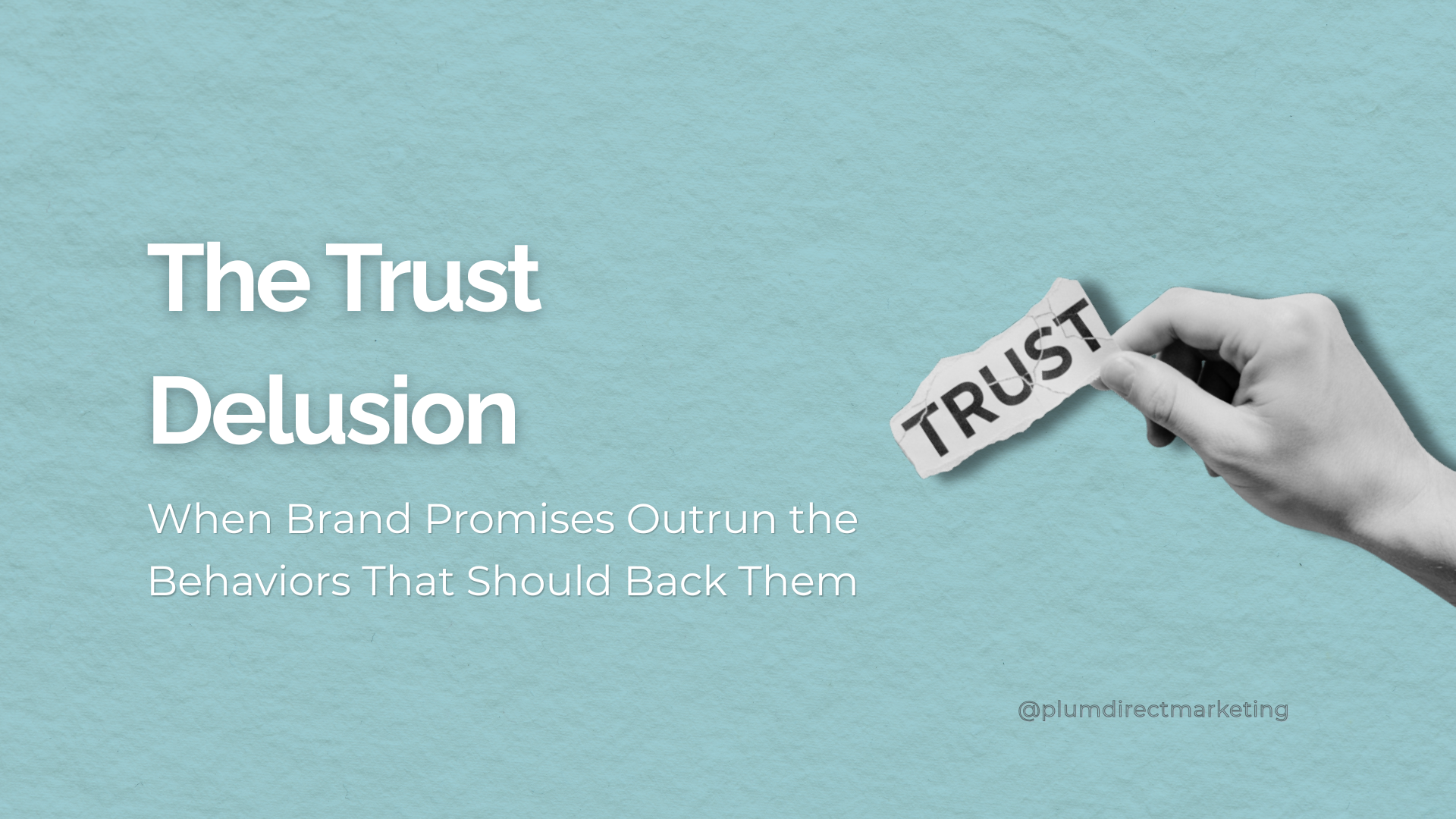
TLDR; “Trust” became marketing’s favorite accessory; and in the process, it lost its meaning.
Everyone claims to “build” it. Few remember what it’s built from. This isn’t another think-piece about authenticity. It’s about what happens when saying trust replaces proving it.
1. The Lie Everyone Repeats
Walk through any airport and you’ll see it plastered everywhere:
“Trusted Since 1984.” “Your Trusted Partner in Finance.” “Care You Can Trust.”
We’ve turned trust into wallpaper. The more we say it, the less anyone hears it.
Real-world moment:
A family calls the “trusted” senior-living community featured in a glossy ad.
They’re met with a phone tree that says, “Press 3 for assistance.” Three transfers later, the line drops.
They don’t hate the brand. They just quietly cross it off the list.
“Marketing says ‘trust us.’ Customer service sends you to voicemail.”
That’s the delusion in one sentence.
2. How ‘Trust’ Got Hijacked
Marketers didn’t kill trust overnight; we commoditized it slowly.
First, we turned it into a KPI.
Then we buried it in dashboards.
Now it’s a tagline with an asterisk.
Proof Points:
- Edelman Trust Barometer (2025): Only 32 % of people believe brands “do what they say.”
- HubSpot Research (2025): 63 % of consumers view over-personalization as a negative trust signal.
- Ipsos (2025): 68 % of consumers “trust very few brands — but buy from them anyway.”
That last line hurts. That’s not loyalty. That’s learned helplessness.
Snapshot 1
You order from a “trusted” online retailer. They promise free returns.
You click Start Return and find out “free” only applies to store credit; minus a $12 restocking fee.
That’s not fraud; it’s erosion. A slow leak in the bucket of belief.
Snapshot 2
Your dentist’s website says “We respect your time.”
You sit in the waiting room for forty-five minutes while the TV loops toothpaste ads.
You don’t complain; you just switch providers next year.
3. The Real Cost of Decorative Trust
When trust becomes decoration, credibility dies quietly.
- Customers stop believing your words; but still use you out of habit.
- Teams stop questioning hollow language; because “that’s marketing’s job.”
- Leadership stops noticing the gap; until it shows up in churn.
Every small dissonance compounds:
the over-polished brochure, the exaggerated review, the “trusted” claim next to a broken contact form.
Trust doesn’t collapse in crisis; it decays in maintenance.
“Most brands don’t have a trust crisis — they have a credibility drip.”
4. A Different Kind of Audit
Forget brand guidelines. Run a credibility audit instead.
Ask these five questions:
Check |
If the answer is no … |
What it really means |
| Can a customer reach a human in under 60 seconds? | Then your “personal service” is fiction. | Trust starts with availability. |
| Do you acknowledge mistakes publicly (online or off)? | Then your “integrity” is conditional. | Silence looks like avoidance. |
| Do you deliver bad news as promptly as good news? | Then you’re managing image, not relationship. | Consistency builds credibility. |
| Would you buy from you after reading your own emails? | Then you’re marketing to your CRM, not your customers. | Empathy shows in tone, not taglines. |
If any of those hurt, that’s good. It means you still care enough to fix them.
5. The Shift from Slogans to Systems
Real trust isn’t a promise. It’s a pattern.
The brands that feel most believable in 2025 aren’t the ones that say trust at all — they show it repeatedly.
Picture this:
A retirement community that admits on its mailer, “Some of our apartments have long wait lists.”
A financial planner who starts a client call with, “Before we start, this isn’t a pitch.”
A dentist who writes, “Running ten minutes behind; thank you for your patience” instead of pretending the delay never happened.
Small, human honesty is the new brand currency.
FAQ
1. What is the “trust delusion” in marketing?
It’s the gap between what brands say (“trust us”) and what their actual systems prove. When trust becomes a tagline instead of a behavior, customers learn to ignore it — even when brands believe they’re being sincere.
2. Why do brands talk about trust so much?
Because it’s easier to claim than to demonstrate. “Trust” became a marketing shortcut: a word added to ads, websites, and taglines without the operational rigor that makes it true.
3. How do customers know when trust isn’t real?
They notice the disconnects: long wait times, hidden fees, poor follow-through, over-personalized messages, or communication that contradicts the brand promise. Credibility erodes quietly through inconsistencies, not scandals.
4. What’s the biggest risk of relying on “decorative trust”?
Customers stop believing you — but keep using you out of habit. That false sense of security leads to churn, declining loyalty, and weak word-of-mouth. It’s not a crisis; it’s slow decay.
5. How can a brand measure real trust?
Not with taglines; with behaviors. Start by auditing:
- Can customers reach a human quickly?
- Do you acknowledge mistakes publicly?
- Is your tone consistent in good and bad news?
-
Would you buy from you after reading your own emails?
These reveal credibility better than any KPI dashboard.
6. What builds trust in 2025?
Small, honest signals. Clear wait times. Direct language. Transparent tradeoffs. Admitting imperfections. People trust patterns, not promises.
7. What industries are most affected by the trust gap?
Healthcare, financial services, senior living, and home services — any sector where vulnerability, urgency, or high-stakes decisions are involved. The higher the stakes, the more destructive the credibility drip.
8. How can marketers fix a trust problem?
By shifting from slogans to systems:
- Align customer service and marketing.
- Remove hidden friction points.
- Communicate bad news as openly as good news.
-
Replace exaggerated language with specific, human honesty.
Trust is rebuilt through operational consistency.
9. Is trust still a competitive advantage?
More than ever. Because so few brands practice it. In a noisy, skeptical market, credibility becomes differentiation.
Ready to Replace “Trust” With Something Real?
If you’re done relying on slogans and want a brand that earns credibility through systems, not promises, we’re here to help. Let’s build the kind of trust your audience can actually feel.
Speak with a Plum strategist →
Up Next: The Anatomy of Real Trust — Five Behaviors That Still Work
If saying “trust us” isn’t enough; what is?
Next, we’ll tear it down to its working parts and show how to rebuild belief one behavior at a time.